Taking your medications according to the instructions given to you by your physician or pharmacist is
known as adherence. Doing so at the times, doses, and frequency established in your care plan is the
most important part of your treatment. If any of these are not followed, we would be in noncompliance with
treatment, which could cause your condition to become uncontrolled and lead to
serious health complications for your health.
More than half of the medications prescribed for different purposes and/or treatments are not used
in the correct way. Non-adherence can be divided into two categories:

Intentional:
the patient decides not to follow treatment recomendations.
Unitentional:
the patient wants to be adherent to the recommended treatment, but you have trouble remember
to take it or it is having undesired effects.
But, how can I improve adherence to medications?

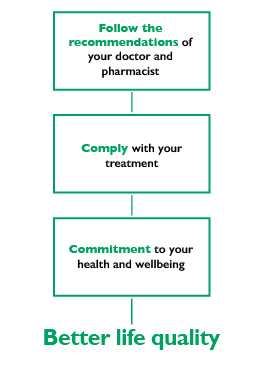
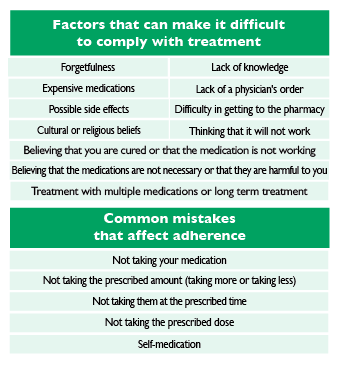
It is important that you are able to identify the factors that make it difficult for you to comply with
your medication therapy.
|
Factors that can make it difficult to comply with treatment
|
| Forgetfulness |
Difficulty in getting to the pharmacy |
| Lack of knowledge |
Cultural or religious beliefs |
| Expensive medications |
Thinking that it will not working |
| Lack of physician's order |
Believing that you are cured or that the medication is not
working |
| Possible side effects |
Believing that the medications are not necessary or that
they are harmful to you |
| Treatment with multiple medications or long term treatment
|
|
Common mistakes that affect adherence
|
| Not taking your medication |
Not taking the prescribed dose |
| Not taking the prescribed dose (taking more or taking
less) |
Not taking them at the prescribed time |
| Self-medication |
How can I improve my
adherence and comply with my medications?
- Help yourself with reminders such as a calendar, alarms, and notes to show when each medication
should be taken. There are also mobile apps for your cell phone to help you stay compliant with
your treatment.
- Have good communication with your health care providers and clarify any questions.
- Use a pillbox and group medications that should be taken in the morning, afternoon, and
evening.
- Ask a family member, friend, or co-worker for support.
- Select a pharmacy that is easily accessible and use the home delivery service. Remember to
order
your medications at least 4 to 5 days before they run out.
- Keep your medications in a visible place.
- Know what medications you take, what you take them for, and the dosage you take.You can even
keep a list of them on hand at all times.
Remember that adherence to treatment is a key health behavior in people with
chronic diseases. Carrying out it helps to keep them under control and have fewer
complications and hospitalizations.
Compliance with treatment is essential for your wellbeing!