Specialty pharmacy drug spend continues to rise year over year. Considering the increase in development and approval of novel drugs, this trend is expected to continue. The recent approval of Zolgensma® at $2.1 million1 doubling the cost of Luxturna® ($850,000)2, signals a new era of drug pricing. Fostering awareness among patients, providers and payers about the management of specialty drugs is critical to help control costs while maintaining access.
Innovation drives progress
Without a doubt, the emergence of specialty medications signifies an important milestone in the history of health care and medicine. These therapies improve the quality of life of patients with debilitating conditions like multiple sclerosis, increase survival rates for cancer patients or even cure chronic Hepatitis C, the leading cause of chronic liver disease. However, all these innovative therapies present new and unique challenges to the health insurance industry.
Next are five things to know about specialty drugs and what must be done to help manage specialty spending.
1. What is a Specialty Drug?
Perhaps the most difficult question. There is no standard definition, rather a definition that continues to evolve. A drug in this category is best defined as having one or more of the following characteristics:
-
Prescribed for a person with a complex or chronic medical condition, defined as a physical, behavioral, or developmental condition that may have no known cure, is progressive, and/or is debilitating or fatal if left untreated or under-treated
-
Treats rare or orphan disease indications
-
Requires additional patient education, monitoring, adherence, and support beyond traditional dispensing activities
-
Is an oral, injectable, inhalable, or infusible drug product
-
Has a high cost
-
Has unique storage or shipment requirements, such as refrigeration
-
Is stocked and dispensed by a specialty pharmacy
But there is another level of complexity. Depending on its attributes, specialty drugs may be paid under the medical or pharmacy benefit, based on the benefit plan design, drug and place of care.
2. New Drug Approval
In the past 10 years the Food & Drug Administration (FDA) has approved 356 novel drugs. This represents an average of 33 approvals per year. Figure 1 shows the number of approved drugs per year.
Number
of Novel
Drugs
Approvals
CDER
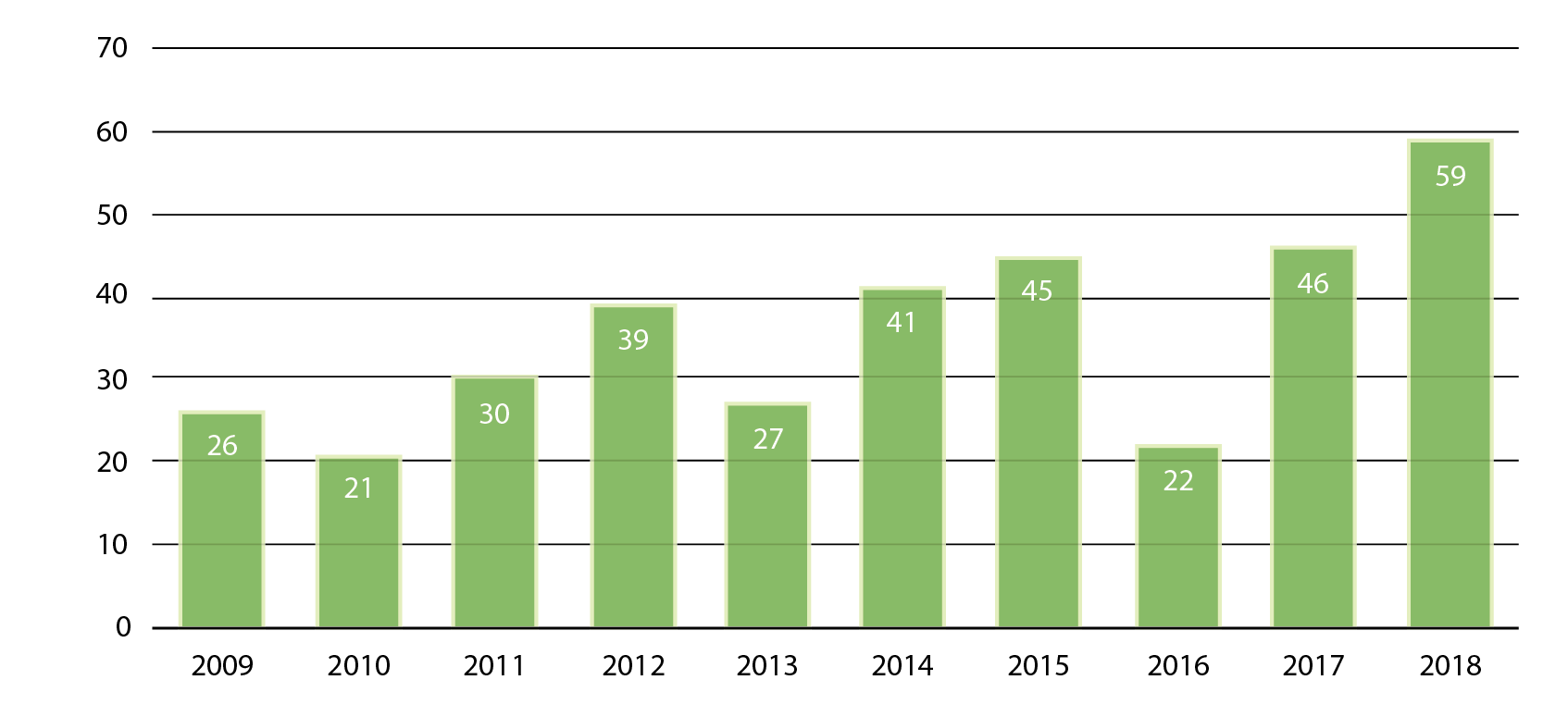
Figure 1. FDA Approvals in the Past 10 years (2009-2018)
Source: US Food and Drug Administration. Center for Drug Evaluation and Research. Advancing Health Through Innovation 2018 New Drug Therapy Approvals. January 2019. Retrieved August 13, 2019, from https://www.fda.gov/media/120357/download
Notwithstanding, 2018 was a record-breaking year for novel drugs approvals by the FDA. The Center for Drug Evaluation and Research (CDER) approved a total of 59 new molecular entities and biologics. Table 1 shows some key categories of drug approvals regarding novel medical treatments:
Table 1. 2018 New Notable Drugs for Rare Conditions and Expedited Pathways
|
Drug designation |
Amount of drugs approved by designation |
|
|
Orphan Drugs to treat rare diseases that affect 200,000 or fewer Americans. Patients often have few or no drugs available to treat their conditions. |
34 drugs |
|
|
Breakthrough Therapies are drugs for serious or life-threatening diseases for which there is unmet medical need and for which there is preliminary clinical evidence demonstrating that the drug may result in substantial improvement. |
14 drugs |
|
|
Priority Review are drugs that could potentially provide a significant advance in medical care |
43 drugs |
|
Source: Adapted from the U.S. Food and Drug Administration. (2019, January). Advancing Health Through Innovation 2018 New Drug Therapy Approvals. Center for Drug Evaluation and Research.
On 2018, cancer continues as a key development area. Out of the 16 new drugs approved, 13 were for rare indications. 2019 should not be an exception as three were approved during the first six months of the year.
Biosimilars are expected to increase competition in the U.S. and expand treatment options. The FDA is doing their part in terms of approvals. However, patent litigations are keeping them out of the market. An FDA-approved biosimilar is highly similar to and has no clinically meaningful differences in terms of safety, purity and potency (safety and effectiveness) from an already FDA-approved biological product. On 2018, a total of 7 new biosimilars were approved for a total of 16 biosimilars approved in the U.S. This includes biosimilars for the top selling biological drugs: Humira®, Rituxan®, Enbrel®, Herceptin®, Avastin®, and Remicade®.
Not to be outshined, the CBER approved two gene therapies in 2017: Luxturna ® , the first directly administered gene therapy for an inherited retinal disease3, and Yescarta® for certain types of adult, large B-cell lymphoma4.
What is the outlook in terms of the specialty drug pipeline? For industry experts it could be summarized in three developments: cancer drugs, orphan drugs, and an increase in competition. More to come.
3. Supplemental Specialty Indications
When a drug is already on the market, the FDA approves a “supplemental indication.” This allows the drug to be used for new conditions or stages of a disease, or additional patient groups. Supplemental indications are a way to expand the use of medications. For example, Humira® was first approved in 2002 for rheumatoid arthritis. In the last years it has obtained nine supplemental indications including psoriasis arthritis, Crohn’s disease and plaque psoriasis. In addition, in 2015 Humira® was approved to treat hidradenitis suppurativa, a rare inflammatory skin condition.
On 2017 Dupixent® was approved to treat atopic dermatitis. Recently, Dupixent® obtained supplemental indications for the treatment of uncontrolled moderate to severe asthma and chronic rhinosinusitis with nasal polyps. The cost per year of the drug starts at $37,000. Industry analysts are expecting higher sales just from the asthma indication.
4. Spending: Traditional Versus Specialty Drugs
Specialty utilization and cost continues to increase. Meanwhile, traditional drug spend continues to decrease. It represents an average of 40% of total pharmacy spend, although representing 1% of prescriptions claims. Specialty spend is forecasted to reach 60% by 2021.
What are the key factors driving the specialty trend?
- Specialty drugs pipeline
- High launch prices
- Increase in utilization
- New indications
- Price inflation on key drug categories
- Population aging
5. Management Strategies
In light of the development and growth of specialty drugs treatments, the best approach includes multiple strategies that address traditional pharmacy managed care and out of the box tools:
- Formulary
- Exclusive Pharmacy Network
- Integration of Medical Data
- Utilization Management
- Clinical Controls
MCS Conexión de Salud is an innovative educational initiative, designed to bring information to our clients, providers and members through creative and efficient communication channels.
1. Onasemnogene abeparvovec-xioi is a prescription adeno-associated virus vector-based gene therapy indicated for the treatment of pediatric patients less than 2 years of age with spinal muscular atrophy (SMA) with bi-allelic mutations in the survival motor neuron 1 (SMN1) gene. Source: Retrieved November 4, 2019, from https://www.zolgensma.com/
2. Voretigene neparvovec-rzyl is a prescription adeno-associated virus vector-based gene therapy indicated for the treatment of patients with confirmed biallelic RPE65 mutation-associated retinal dystrophy. Patients must have viable retinal cells as determined by the treating physician(s). Source: Retrieved November4, 2019, from https://luxturna.com/
3. Source: Retrieved November 4, 2019, from https://www.fda.gov/vaccines-blood-biologics/development-approval-process-cber/2017-biological-license-application-approvals
4. axicabtagene ciloleucel is indicated for the treatment of adult patients with relapsed or refractory large B-cell lymphoma after two or more lines of systemic therapy, including diffuse large B-cell lymphoma (DLBCL) not otherwise specified, primary mediastinal large B-cell lymphoma, high grade B-cell lymphoma, and DLBCL arising from follicular lymphoma. Axicabtagene ciloleucel is not indicated for the treatment of patients with primary central nervous system lymphoma. Source: Retrieved November 4, 2019, from https://www.fda.gov/vaccines-blood-biologics/development-approval-process-cber/2017-biological-license-application-approvals